
 English
 Español
 Français
 Português
 Deutsch
 Italiano
 Русский
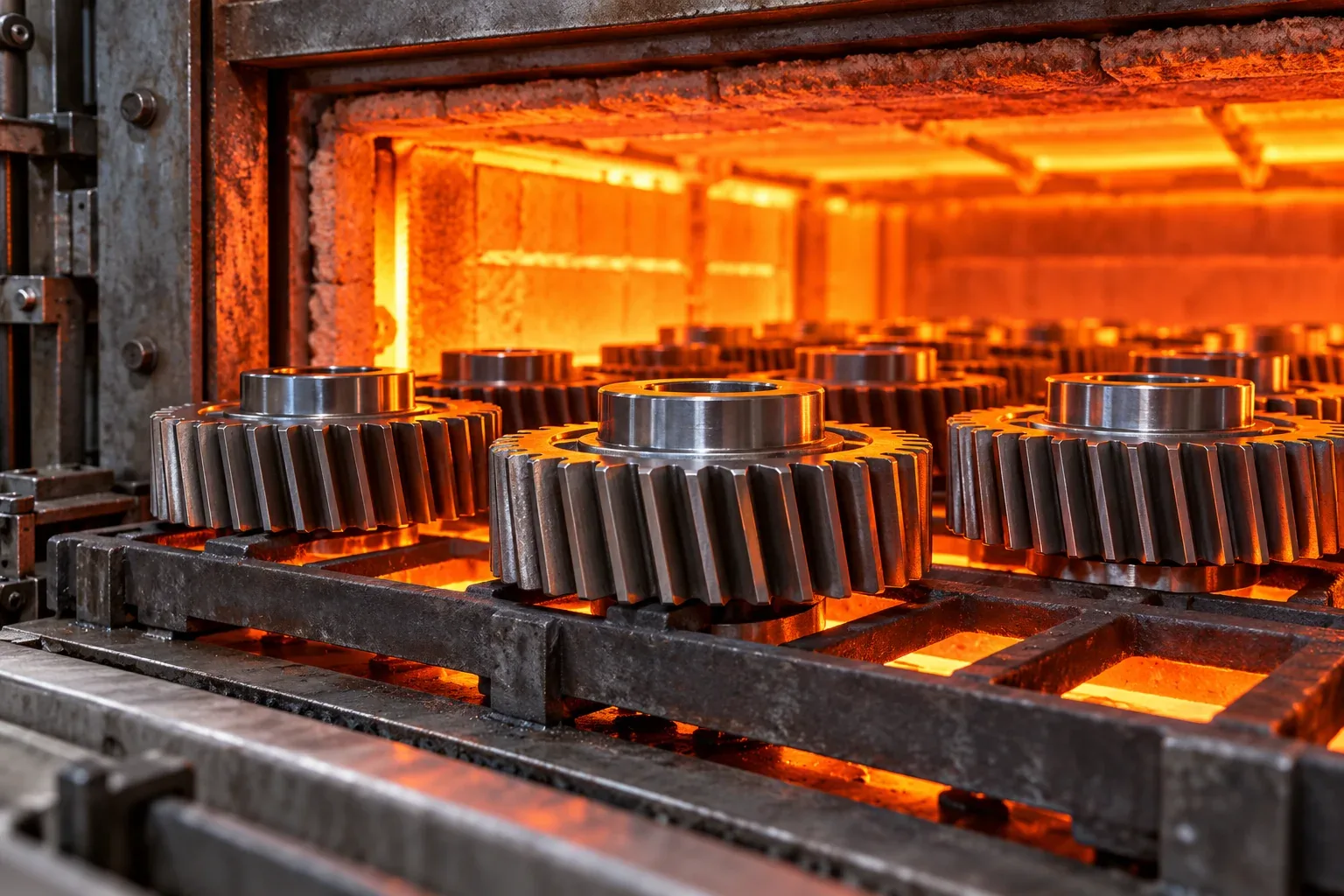
Why heat treatment decides gear life
Heat treatment decides how long a gear lasts. A tooth needs a hard, wear-resistant surface to survive contact stress, and a tougher core underneath to absorb shock loads without cracking.
At our Bhiwadi plant, every crown wheel & pinion set, transmission gear, axle shaft and bevel gear is heat-treated in-house, so hardness, case depth and distortion are controlled by the same team that cut the teeth. Many gear suppliers send this stage out; we don't.
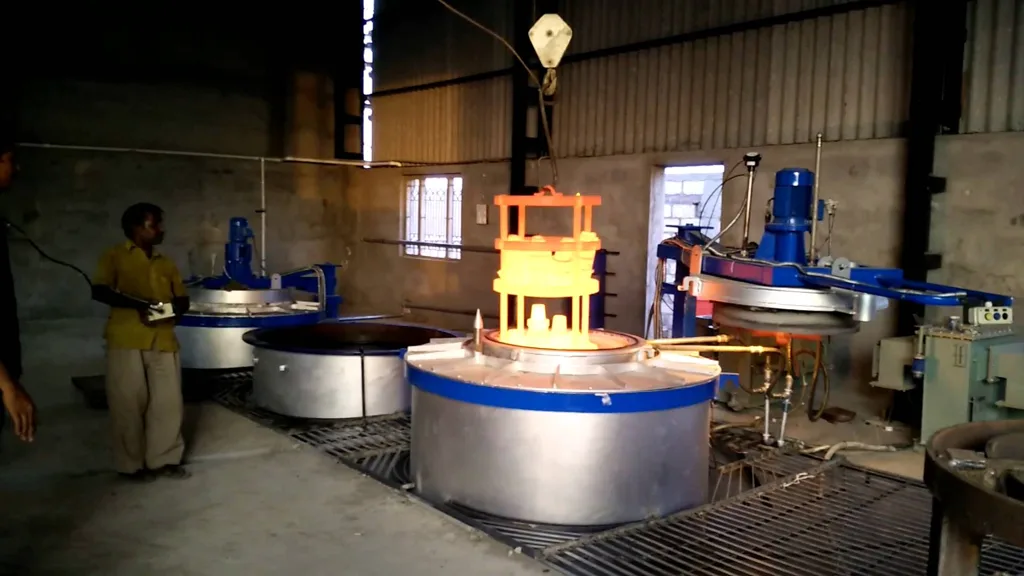
Gas carburising and sealed-quench hardening
Components are case-hardened in gas carburising furnaces. Carbon diffuses into the surface of low-carbon alloy steels, and the parts are then hardened by sealed quenching, which keeps the atmosphere controlled from furnace to quench and limits oxidation and distortion.
| Property | What we achieve |
|---|---|
| Effective case depth | 0.8–1.8 mm, set to tooth size and duty |
| Surface hardness | 58–60 HRC |
| Core hardness | 33–38 HRC |
| Steels | 20MnCr5, SAE 8620, EN353 |
| Distortion control | Sealed quenching; bores and shafts ground after hardening |
| Surface finishing | Shot blasting; shot peening for fatigue life |
Case depth matched to the application
Case depth is chosen for each part, not fixed. Tractor and construction crown wheel & pinion sets that see repeated shock loads run at the deep end of the range, 1.4–1.8 mm. Lighter automotive and industrial gears use a shallower case for a tougher tooth. Shot peening adds compressive stress at the tooth root, the point where fatigue cracks usually start.
Checked before the part moves on
Hardness is verified on Rockwell and Brinell testers, and metallurgical checks confirm the properties of the finished part. After heat treatment, crown wheels and pinions are lapped and roll-tested as matched pairs, and bores and shafts are ground to size. Results are recorded on our in-line inspection sheets, and a full PPAP is run for every new or reverse-engineered part before production. See Quality and Inspection & Metrology.
Discuss your component →Frequently asked questions
What case depth do you use?
Between 0.8 and 1.8 mm, depending on tooth size and load. Heavy-duty tractor and construction gears are carburised to 1.4–1.8 mm.
What hardness do your gears reach?
58–60 HRC at the surface and 33–38 HRC at the core.
Can you heat-treat to our drawing specification?
Yes. Case depth, hardness and steel grade are set from your drawing, and checked before dispatch.
Do you offer shot peening?
Yes, along with shot blasting, to improve fatigue life at the tooth root.
Used on: Crown Wheel & Pinion Sets · Transmission Gears & Shafts · Axle Shafts · Agricultural · Construction & Mining